

Call Us

Contact Us
What can you expect from a John Deere X9 1000 during corn harvest? From high-capacity harvesting and a 16-row corn head to automation that helps manage combine settings and unloading, the X9 1000 brings several technologies together in one harvesting system.
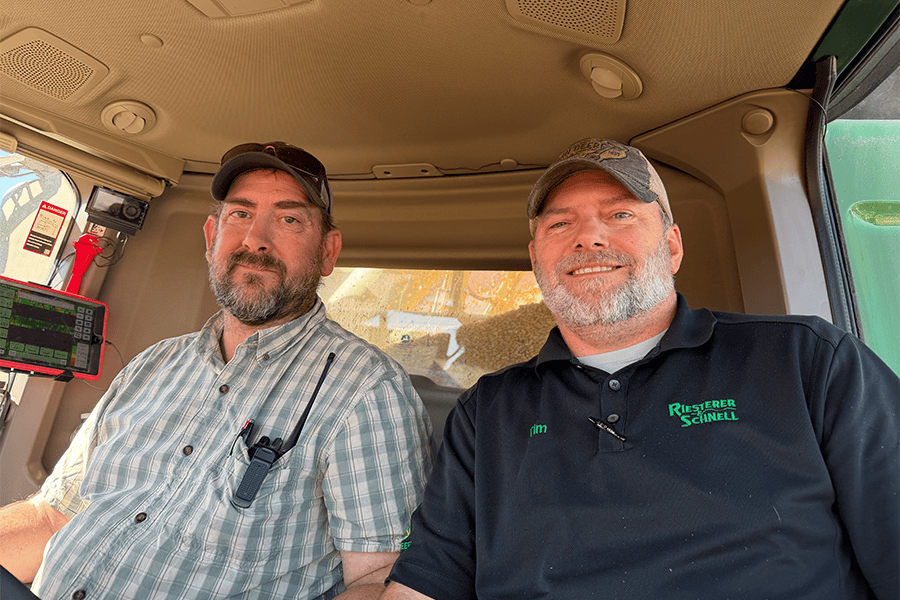
Riesterer & Schnell recently joined Bacon Farms in the cab of their John Deere X9 1000 during corn harvest in central Wisconsin. Their experience provides a firsthand look at how the X9 performs in real field conditions and how its technology can help an operator manage a demanding harvest.
Capacity is one of the biggest considerations when choosing a combine.
During corn harvest, Bacon Farms reported regularly running approximately 5,500 bushels per hour and exceeding 6,000 bushels per hour in good corn with their X9 1000.
Actual harvesting capacity will vary based on crop conditions, yield, moisture, field conditions, header configuration and other factors. But the experience at Bacon Farms demonstrates the amount of crop that can move through the X9 1000 in favorable conditions.
That capacity is paired with a 16-row John Deere CF16 folding corn head equipped with RowMax StalkMaster chopping rolls.
Moving to a 16-row corn head puts a large amount of crop in front of the combine. It also requires the operator to manage a much wider head while maintaining productivity through the field.
After running the CF16, Bacon Farms found the X9 1000 capable of handling the larger head and the crop flow that comes with it.
There is another benefit to the 16-row configuration for farms planting with a 16-row planter.
Bacon Farms previously harvested with a 12-row corn head behind a 16-row planter. That combination meant working with guess rows that did not always align perfectly. Pairing a 16-row corn head with a 16-row planter has helped reduce those alignment challenges during harvest.
One of the technologies being used on the Bacon Farms X9 1000 is Auto Unload.
The farm was already familiar with John Deere Machine Sync before adding Auto Unload. With the new unloading technology, less operator attention is required to manage the grain cart while unloading on the go.
For the combine operator, that means more attention can remain on the corn head and harvesting conditions while the technology helps manage filling the grain cart.
There was a learning curve during the first several loads. As more loads were completed, the operator found the system increasingly easy to use and liked its performance with the farm’s longer grain carts.
The technology does not eliminate operator involvement. Operator preference still plays an important role. For this operation, however, AutoUnload has become a feature they would choose again.
Keeping a combine properly adjusted can become more challenging as crop conditions change throughout the field.
Harvest Settings Automation is being used on the X9 1000 at Bacon Farms to help manage those changing conditions.
During harvest, the operator experimented with running both with and without automation. With the system operating, it was able to adjust as conditions changed while maintaining a similar grain sample.
There are still difficult conditions when the operator may prefer to turn the automation off and manage the machine manually. For most conditions experienced during the season, Bacon Farms preferred running with the automation enabled.
This is an important part of the overall X9 experience. The goal is not simply moving more crop through the machine. It is giving the operator technology that can help manage combine performance while allowing more attention to be placed on harvesting.
Operators familiar with John Deere S700 Series combines may find the transition to an X9 more familiar than expected.
Inside the cab, Bacon Farms found the control layout similar to its previous S700 Series combines. One of the more noticeable changes was moving from a Gen 4 display to the Gen 5 display.
After gaining experience with the Gen 5 display, the operator was able to arrange the screen around the information he wanted to monitor. The dual-display configuration was also a feature Bacon Farms particularly valued.
Outside the cab, the differences become more apparent.
The X9 has a significantly larger cleaning system and uses heavy-duty belt drives in several areas. From the farm’s experience, the machine is laid out to make maintenance and crop changeover manageable.
Switching between corn and soybeans was also described as straightforward, including changing the chopper between high and low gear.
When combine and header capacity increase, grain handling has to keep pace.
The Bacon Farms X9 1000 uses a 28.5-foot folding unloading auger compared with the 26-foot auger used on its previous machine.
The additional length provides more reach while unloading. When it is time to travel, the ability to fold the auger reduces how far it extends behind the combine. That can be particularly useful when maneuvering around trees and other obstacles.
The folding process was also found to be quick enough that it did not interfere with harvesting.
Another useful feature is the unloading auger cleanout. The operator can shut off the drag augers while allowing the unloading auger to continue running. This allows the auger to finish cleaning out rather than leaving additional grain weight in the auger.
One of the best demonstrations came during the podcast itself.
While the conversation was taking place inside the cab, the X9 1000 was harvesting with a 16-row corn head, unloading on the go and working through areas of down corn.
That real-world experience helps demonstrate what the X9 is designed to bring together: capacity, harvesting technology, automation and an operator environment that allows multiple functions to be managed from the cab.
For Bacon Farms, the first season with the John Deere X9 1000 provided an opportunity to put those capabilities to work in actual central Wisconsin corn harvest conditions.
Combine selection is about more than choosing the machine with the greatest capacity. The right harvesting setup depends on your acres, crops, headers, planting configuration, grain handling system and the technology you want to use during harvest.
The John Deere X9 1000 combines high-capacity harvesting with technologies such as AutoUnload, Harvest Settings Automation, Machine Sync and the Gen 5 display. Pairing the combine with a larger corn head such as the CF16 can create a harvesting system designed to keep crop moving while helping the operator manage changing field conditions.
If you're considering an X9 or evaluating your next combine and header setup, talk with the team at Riesterer & Schnell about the configuration that makes the most sense for your operation.
Watch or listen to the full Leap Forward Podcast episode for an inside-the-cab look at Bacon Farms' experience with the John Deere X9 1000 and CF16 corn head.


